

As of July 6, 2026, the University of Washington has implemented a 60-Day Reimbursement Policy impacting how employees (including student employees) are reimbursed for travel and non-travel purchases. For more information on this important change, see the resource section.
Purchase Reimbursement
Reimbursements for expenses incurred by a UW employee or guest for the purchase of goods (not services) on behalf of UW business.
Travel Reimbursement
Reimbursements for expenses incurred by a UW employee or guest while traveling on behalf of UW business.
Travel Advance
A Travel Advance (also known as a per diem advance) can be requested through a spend authorization to defray costs a UW employee traveler may incur while traveling on official UW business. In Workday, Travel Advance is under a spend authorization process (SA-000000000XXX). If submitting more than 30 days before the date of travel, AST work with you on the request in preparation and will hold this request until it can be submitted.
On this Page...
- Resources
- Applying the 60-Day Reimbursement Policy
- 60-Day Expense Policy FAQs
- Selecting the Correct Reimbursement Form
- AST's Reimbursement Decision Tree
- Purchase Reimbursement Form Checklist
- Travel Reimbursement Form Checklist
- Travel Advance Form Request Checklist
- Applying the 90-Day Reimbursement Policy
- Applying the 60-Day Reimbursement Policy
- Workflows
- Guest Purchase and Travel Reimbursement Processing Time and Workflow
- UW Employee Purchase and Travel Reimbursement Processing Time and Workflow
- Frequently Asked Questions: General Reimbursement
- What expenses cannot be reimbursed?/ List of non-reimbursable expenses.
- Is registration for conferences taking place in Washington State taxable?
- Where and/or how can I make a check deposit?
- Where can our department find more information on what payments and reimbursements can be processed for foreign nationals?
- Which AST form should I use for reimbursements?
- Can individuals be reimbursed for services they paid out of pocket?
- What do I need to submit for my food reimbursement?
- Do I need a receipt? What if I lost my receipt?
- What if the receipt is under another person’s name?
- What if I reimbursed another person who paid for both of us. Can I be reimbursed?
- What if I paid for another UW employee or guest? Can I be reimbursed?
- May I be reimbursed if I use Zelle, Venmo, or any other peer-to-peer service to pay for UW expenses?
- May I be reimbursed if I make purchases using a rewards program (mileage points, credit card rewards program, gift cards, etc.)?
- May I be reimbursed for purchases made with a gift card?
- May I be reimbursed if I purchase gift cards for employee recognition?
- May I be reimbursed for a book I have authored if I am a faculty member?
- If I get reimbursed for a good, will this become UW property?
- Frequently Asked Questions: Travel Reimbursement
- What receipts do I need to submit for reimbursement when traveling?
- What is a per diem?
- What pre-trip reimbursements are available to me?
- May I be reimbursed if I make purchases using rewards programs (mileage points, credit card rewards program, gift cards, etc.)?
- Do I need a receipt for reimbursement?
- What travel upgrades can I be reimbursed for?
- Can I take personal time on a trip?
- What is a flight comparison?
- Do I need to register for my international travel?
- Can I get reimbursed for a package deal; airline and hotel?
- What do I need for a car rental?
- Can I get reimbursed for gas?
- What information do you need from me or my department to issue an advance?
Resources
Back to TopApplying the 60-Day Reimbursement Policy
The University of Washington has significantly changed how employees (including student employees) are reimbursed for travel and non-travel purchases.
As of July 6, 2026, the UW has adopted Rule 2 of the IRS Accountable Plan (also referenced in SAAM 10.80.70.b). Under this policy, expenses incurred by employees (including student employees) must be substantiated within a reasonable time period.
If the expense reimbursement isn’t submitted within the reasonable time period, the expense will be treated as taxable income. The reimbursement will still be processed but it will be processed via payroll to ensure the applicable payroll withholding taxes are applied from the employee’s next semi-monthly earnings.
For purposes of this policy, as stated in the Safe Harbor established in IRS Section 1.62-2(g)(2)(i), the UW will define a “reasonable period” as 60 days. The 60-day clock starts:
- From the date the trip ends for travel expenses (last day of the trip, including personal time)
- From the date of purchase for non-travel expenses
Expenses substantiated on an expense report within this 60-day period will satisfy the reasonable time period requirement and will not be considered income. Expenses substantiated after the 60-day period and don’t qualify for exceptions outlined below will still be reimbursed, but included in the employee’s payroll as described above.
There are allowable exceptions to this policy; any exception will require documentation. The allowable exceptions include:
- The employee was on an approved extended leave of absence.
- Documentation requirement: Department confirmation of extended leave of absence.
- The employee was on business travel status for over 60 days.
- Documentation requirement: Trip pre-approval, documentation substantiating continuous 60-day travel.
- The delayed submission of the expense report was caused by the Shared Environment and/or department personnel other than the employee seeking reimbursement.
- Documentation requirement: Shared Environment Director (for AST delay) or Department Chair with Divisional Dean co-signature explanation and approval.
60-Day Reimbursement Policy FAQs
AST has compiled the following frequently asked questions (FAQs) regarding the new 60-day reimbursement policy. If you have any questions that were not answered, please contact AST and we will address them in an upcoming newsletter.
What transaction timeline does this policy apply to?
Any transaction submitted after July 6. Examples include:
| Type and date of transaction | Date submitted for processing | Appliable policy |
|---|---|---|
| Travel from 6/1/2026—6/15/2026 | Submitted on 6/20/2026 | Current 90-day policy applies |
| Purchase on 6/1/2026 | Submitted on 6/5/2026 | Current 90-day policy applies |
| Travel from 4/1/2026—4/10/2026 | Submitted on 6/20/2026 | Current 90-day policy applies |
| Travel from 2/1/2026—2/5/2026 | Submitted on 6/10/2026 | Current 90-day policy applies |
| Travel from 6/15/2026—6/29/2026 | Submitted on 7/7/2026 | New 60-day policy applies |
| Purchase on 1/31/2026 | Submitted on 7/6/2026 | New 60-day policy applies |
| Purchase on 7/1/2026 | Submitted on 9/9/2026 | New 60-day policy applies |
What if the payment needed to be reissued after 60 days of the initial submission?
There is no impact if payment needs to be reissued. The payment will be reissued with no change to the taxability status of the payment.
The employee delayed submission due to a funding source issue—is this an allowable exception?
Yes. Please attach an explanation of the delay and, if approved, processed as an approved exception as a delay caused by a department.
Will there be any grace period as the College adapts to this change?
No. Only reimbursements which are included in the allowable exceptions list will be granted an exemption.
What if my conference registration is paid in advance of the conference? Will this expense be reimbursable as part of the travel expense?
Conference registration can either be part of the travel expense or paid separately. If it is included with the travel, the last day of travel will be the date used to calculate the application of the 60-day expense policy across all associated travel expenses. If it submitted separately, the day the expense is paid will be the date used to calculate the application of the 60-day expense policy.
Each department manages conference registration differently, and each conference has a different cadence and requirement. Note the following advantages and disadvantages to each reimbursement option:
- If submitted as part of travel: The conference registration can be included in the set of receipts submitted at the end of travel, even if the expense occurs well in advance. UW Travel had validated that this option will not need an exemption from the new policy as long as the travel expenses are submitted within 60 days of the travel end date. The advantage of choosing this option is the department and the traveler have a complete set of expenses all submitted at the same time. The disadvantage is the traveler may be floating the expense of the conference registration for a long time.
- If submitted separately: Submit the conference registration at the time of the expense and then submit a second set of expenses at the end of travel. The advantage of choosing this option is the traveler does not incur the expense with a long wait time before the full reimbursement. The disadvantage is tracking for both the traveler and the department on which associated travel expenses have been submitted or not.
Does the 90-day policy still apply?
Yes. Both policies now apply in tandem. Receipts that are 60 to 90 days old will be processed as taxable income. Receipts that are over 90 days old will still be processed as taxable income and will also require Divisional Dean approval. Please see the 90-day reimbursement policy for more details.
What if I am on hiatus? Does the 60-day policy apply?
Yes. However, if you are on full hiatus and the expense incurred was directly before the hiatus, an exception can be applied for being out of office on approved extended leave. If you are on a partial hiatus, then the exception will not apply.
There are separate reimbursement forms, depending upon the recipient and the type of reimbursement. Workday requires different information for different populations, and we have crafted our forms to meet these needs.
When requesting a reimbursement for/as a UW employee, use the following:
- UW Reimbursements form for purchase reimbursements
- UW Travel form for travel reimbursements
- UW Travel and Field Advance form for requesting or reconciling travel and/or field advances
When requesting a reimbursement for a non-UW employee or guest, use the Guest Payments and Reimbursements form.
AST's Reimbursement Decision Tree
View this reimbursement decision tree to help understand the correct reimbursement form to use based on your department's situation.
The following decision tree image links to a PDF where you can scale to your liking. This decision tree is also available in a Word document (Reimbursement Decision Tree).

Before requesting an purchase reimbursement, we strongly recommend that you check out the Purchase Reimbursement Checklist (Word Doc) for details about the required information and documents you'll need to include when filling out the UW Reimbursements form (for UW employees) or the Guest Payments and Reimbursements form (for guests or non-UW employees).
Download a copy of the document if you have any issues accessing links.
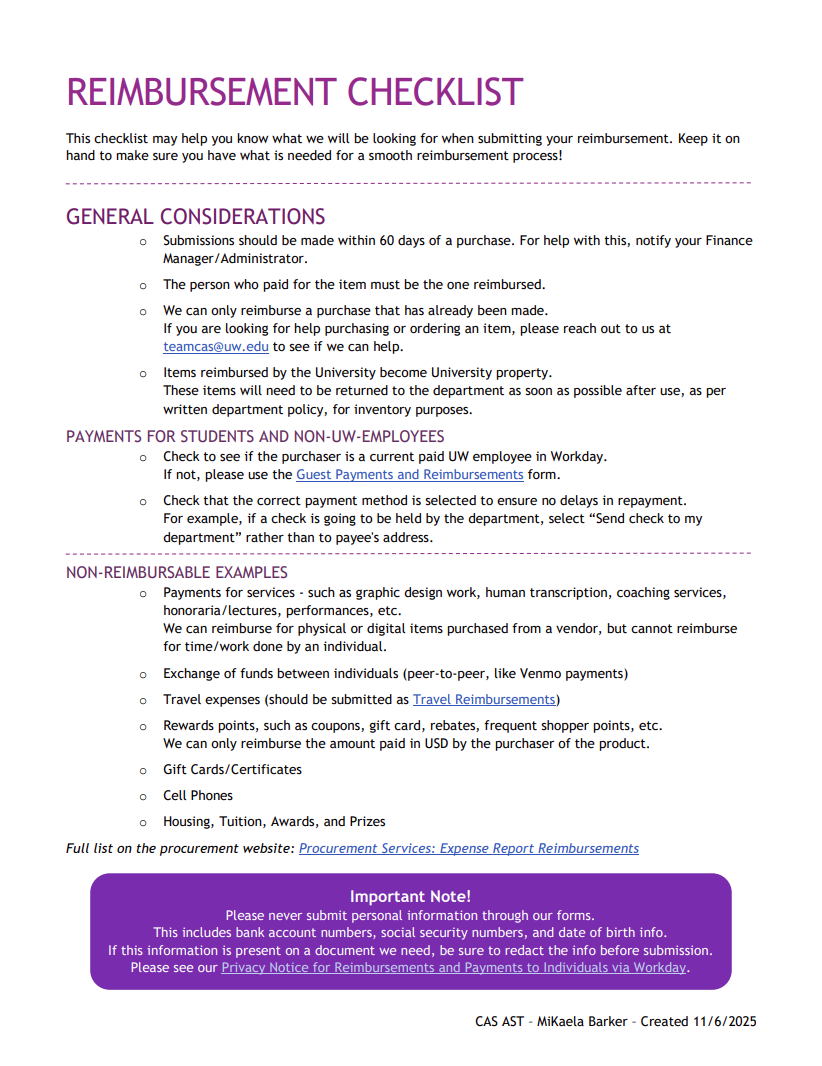
At a high level, you'll need to include the following when requesting a purchase reimbursement:
- Itemized receipts that include:
- Date of purchase
- Amount charged
- Proof of payment or payment method of purchase
At a high level, you'll need to include the following when requesting a purchase reimbursement for FOOD:
- List of attendees (if event is open to public, list estimated total number of attendees)
- Signed food form that is either:
- attached to request, or
- on file in the department
- Note: no food forms are required if the reimbursement is on discretionary resource funding (RS100203)
- No alcohol can be reimbursed, unless the reimbursement is on discretionary resource funding (RS100203)
Note: Reimbursements for meals are typically limited to the same meal per diem rate as listed on the UW Travel Office's Per Diem page.
Before requesting a travel reimbursement, we strongly recommend that you check out the Travel Reimbursement Checklist (Word Doc) for details about the required information and documents you'll need to include when filling out the UW Travel Reimbursements form (for UW employees) or the Guest Payments and Reimbursements form (for guests or non-UW employees).
Download a copy of the document if you have any issues accessing links.
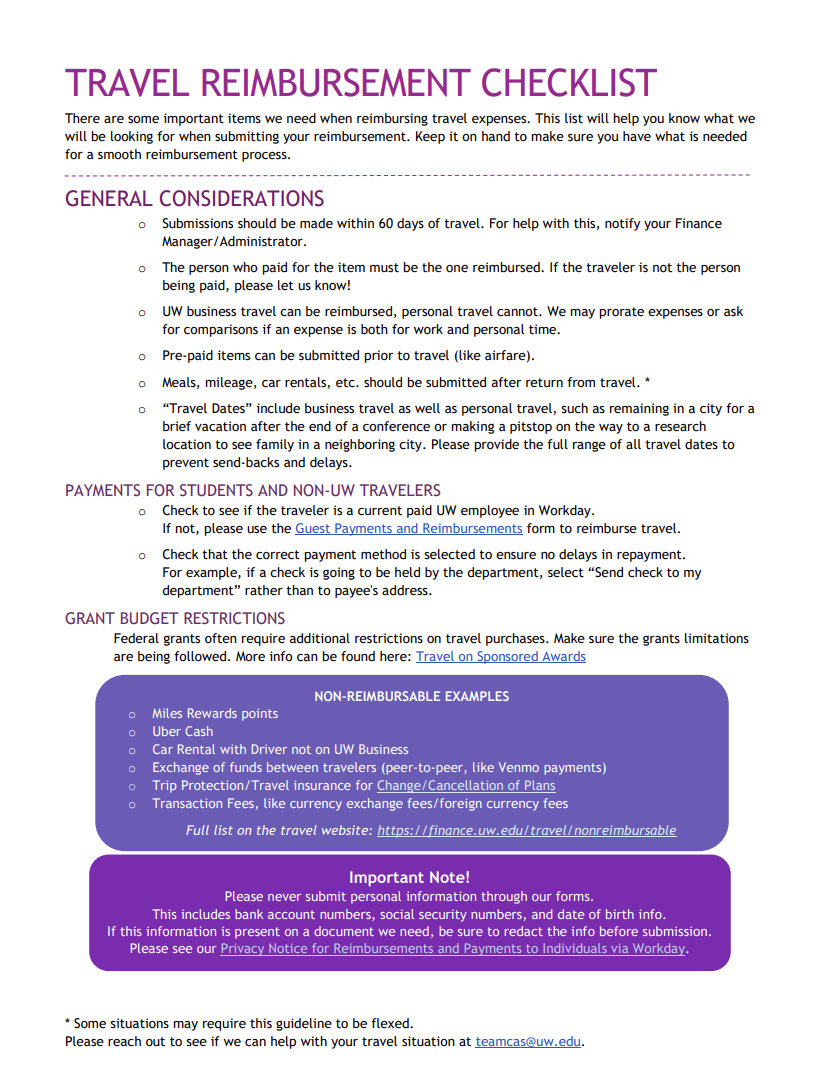
At a high level, you'll need to include the following when requesting all travel reimbursements:
- Location, dates, and times of travel status (and personal time, if taken)
Lodging involved, include:
- Folio/receipt with
- Dates of check in and check out
- Hotel location
- Traveler's name
- Amount charged
- Proof of payment/payment method
- Itemized daily charges
Flights involved, include:
- Itemized itinerary, including:
- Name of flight carrier
- Dates and times of flights
- Traveler's name
- Charges per person with tax paid
- Proof of payment/payment method
- Upgrades for seat selection or class (Premium, Comfort, Business, etc.) require additional approval
- If personal time was taken, comparison airfare at the time of booking
Meals involved, include:
- List of meals provided to traveler (i.e. conference meals, hotel breakfasts, meeting-provided meals, etc.)
- Itemized receipts only if AST is calculating meals
- When requesting reimbursement for providing meals for others,
- Itemized receipts (required by UW Travel Services)
- List of attendees for each meal and their relationship to UW
Car Rental and Gas Expenses involved, include:
- Final rental agreement, including
- Pick-up and drop-off date and time
- Driver name
- Car class (vehicles larger than sedan/standard class are considered upgrades and also require business justification)
- Itemized charges
- Itemized insurance items
- Proof of payment/method of payment
- Gas receipts
Ground Travel involved, include:
- Uber, Lyft, or taxi
- Itemized receipt with proof of payment
- Any upgrades above basic fare and extra fees (i.e. wait fees, priority pickup, etc.) require additional approval
- Mileage
- Personal vehicle mileage total with documentation (i.e. Google map showing miles traveled, mileage log with odometer readings, or UW mileage log)
- Parking
- Receipt indicating amount paid, date, and location
- Tolls
- Receipt indicating amount paid and date
- Ferry
- Itemized receipt
- If receipt shows other passengers, include their full names and UW affiliations
- Public Transit
- Receipt indicating amount paid, date, and location
- Train
- Itemized receipt, including the name of the traveler
- If seat is business class or higher, additional approval from Dean is required
Miscellaneous Travel Costs
- Visa or passport fees
- Receipt of visa fee paid
- Baggage fees
- Receipt indicating amount paid and date
- Registration fees
- Confirmation or receipt indicating registration date, amount paid, name of meeting/conference/etc.
- Internet or WiFi
- Receipt indicating amount paid and date used for UW business
Certain miscellaneous travel expenses can be reimbursed up to $75 without a receipt. For more information, see the UW Travel Receipts and Record Retention page.
There are many state and federal policies, and we recommend you visit the UW Travel page for best guidance.
Before filling out AST's UW Travel and Field Advance form — to request an advance, ensure you have the following information:
- Name of traveler
- Dollar Amount
- Proposed use of advance (i.e. meal per diem)
- Location and UW business reason for advance (e.g. Buenos Aires, Argentina for research)
- Foundation Data Model (FDM)/Finance worktags
Once the traveler has concluded their trip, a reconciliation of the advance will occur in Workday.
The following guidelines and parameters for a travel advance include:
- Issued within 30 days prior to travel start date
- Covers only lodging and/or meals
- Travel length is 90 days or less
- Amount requested is more than $300
- Must be issued on GOF/DOF funds and cannot be on grant funds
- Must be reconciled within 60 days from the travel end date
The 90-day countdown on all receipts begins once travel is complete. Conference registration, airline, and lodging costs are included as part of the overall travel expense packet, and may be reimbursed prior to travel (if pre-paid), subject to the receipt requirements from UW Travel.
Dean’s approval is required if receipts are submitted for reimbursement more than 90 after the end of travel.
Important Note: Purchase reimbursements that are not submitted as travel will still require the department or caller to get Dean's approval for receipts that are older than 90 days (i.e. registrations or memberships for which there are no travel dates or itineraries to reference).
Workflows
Back to TopGuest Purchase and Travel Reimbursement Processing Time and Workflow
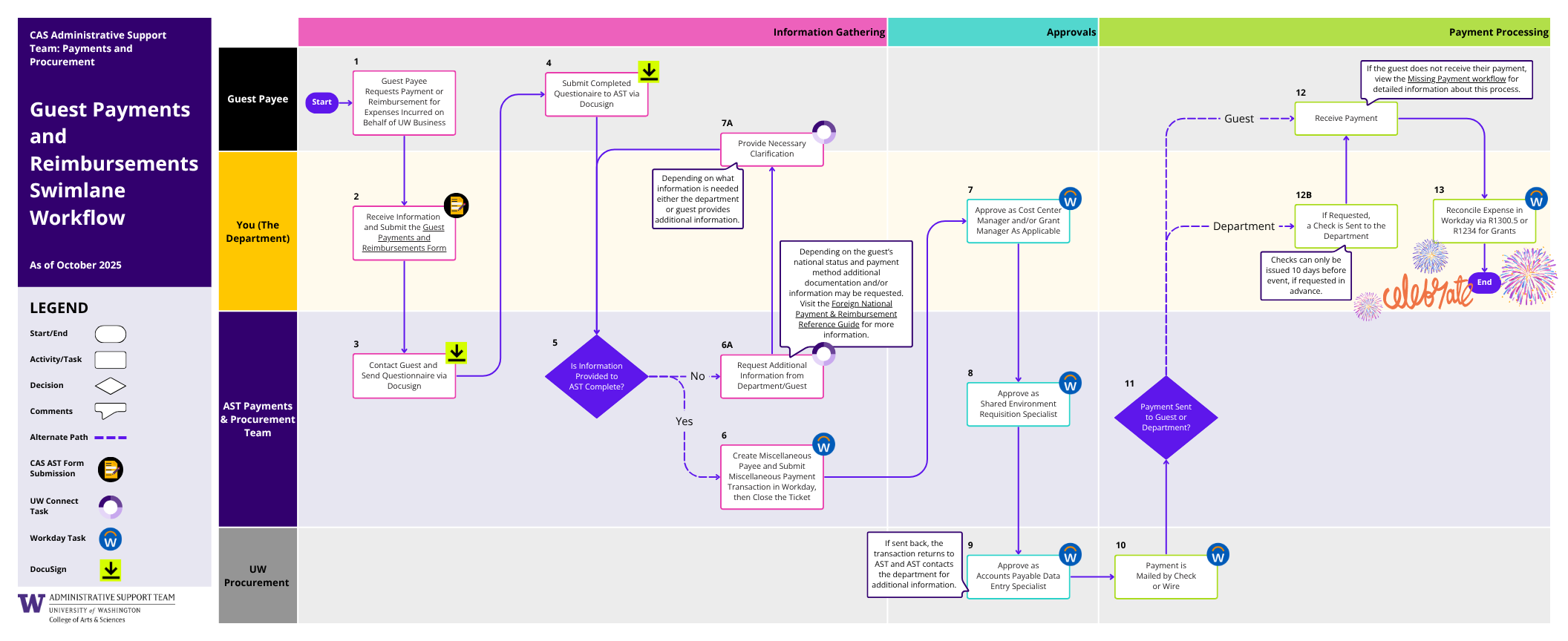
The turnaround time for processing a guest purchase or travel reimbursement is approximately 10 – 21 business days for US citizens and approximately 1 – 3 months for foreign nationals. The timeline is critically dependent on responses from payees. For travel, the timeline is also dependent on responses from Travel Services.
The following workflow image links to a PDF where you can scale to your liking. This workflow is also available in a Word document (Guest Purchase and Travel Reimbursement).
UW Employee Purchase and Travel Reimbursement Processing Time and Workflow
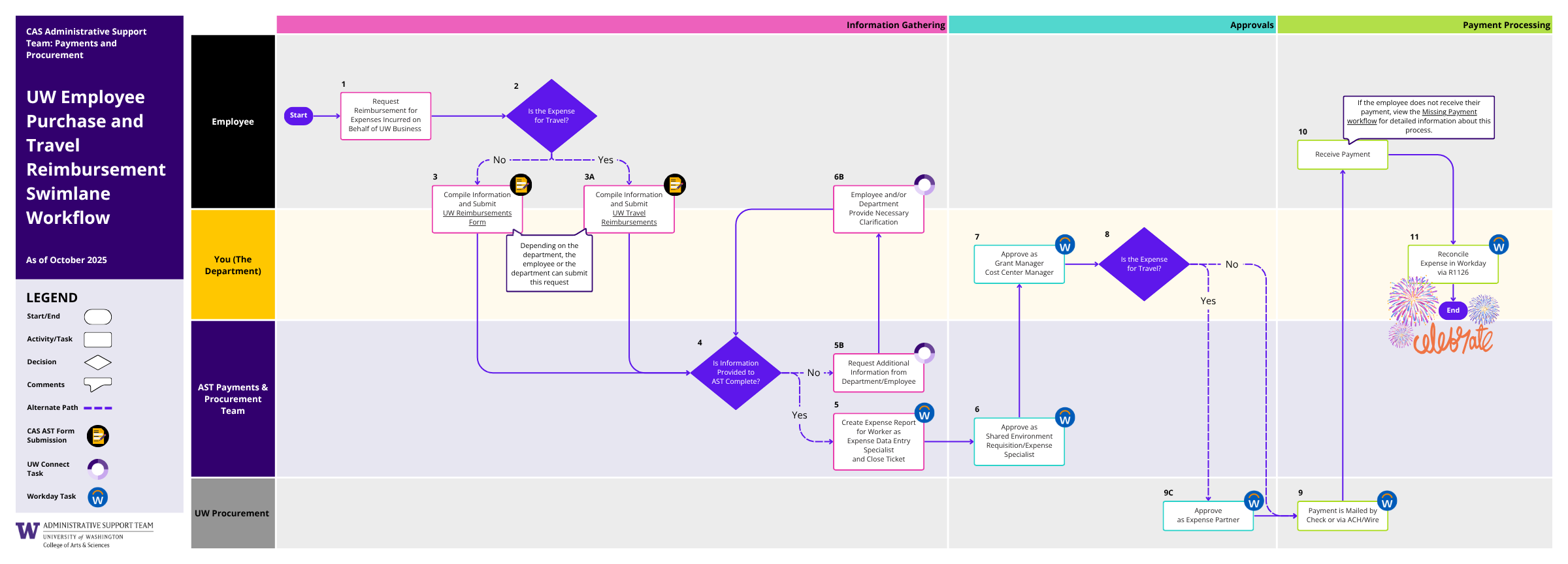
The turnaround time for processing a UW employee travel or purchase reimbursement is approximately 1 – 4 business days. For travel, the timeline is critically dependent on responses from payees and Travel Services.
The following workflow image links to a PDF where you can scale to your liking. This workflow is also available in a Word document (UW Employee Purchase and Travel Reimbursement).
Frequently Asked Questions: General Reimbursement
Back to Top- Payments for services - such as graphic design work, human transcription, coaching services, honoraria/lectures, performances, etc.
- We can reimburse for physical or digital items purchased from a vendor, but cannot reimburse for time/work done by an individual.
- Exchange of funds between individuals (peer-to-peer, like Venmo payments)
- Travel expenses (should be submitted as Travel Reimbursements)
- Rewards points, such as coupons, gift card, rebates, frequent shopper points, etc.
- We can only reimburse the amount paid in USD by the purchaser of the product.
- Gift Cards/Certificates
- Cell Phones
- Housing, Tuition, Awards, and Prizes
- Prolific
- After December 31, 2026, CAS will no longer reimburse employees for personal Adobe Acrobat Pro or Creative Cloud licenses or allow these purchases on ProCard.
- Adobe Acrobat Pro is now available at no cost when using the UW license via UW-IT. Please note that you must still request access to it.
- Adobe Creative Cloud Suite (which already includes Adobe Acrobat Pro) is now $35 per year when using the UW-IT license.
Full list on the procurement website: Procurement Services: Expense Report Reimbursements
Yes, Washington State changed the taxability for some items on October 1, 2025. If no sales tax was originally charged, use tax will be added during the reimbursement or ProCard reconciliation process. You will also see a new expense item on travel reimbursements that specifies that the conference takes place in Washington State.
Registrations for conferences taking place outside of Washington State will continue to be considered non-taxable, and the process will not change.
All checks received by campus departments—whether related to Workday invoices or not—must be mailed to the Bank of America lockbox.
To ensure proper handling, please complete the Cash Remittance Form (UW NetID required) and required cover sheet, then follow Bank and Accounting Operations procedures (UW NetID required), where you'll find the cover sheet instructions and address for the Bank of America lockbox.
Note: Be sure to include any applicable Workday reference numbers to the Cash Remittance Form to inform central offices where the check is coming from and where to apply the funds.
The Foreign National Payment & Reimbursement Reference Guide is designed as a quick guide AST created to help units determine what payments and reimbursements can be processed for foreign nationals. This reference addresses students, scholars, and employees on UW-sponsored visas, as well as those at other US institutions or visiting the US on other visas types.
When submitting a reimbursement, please note there are separate forms to use depending upon the recipient. We’ve updated the naming conventions on our reimbursement forms to make this more clear for ticket submitters. For UW employees, please use the UW Reimbursements or the UW Travel form for purchase and travel reimbursements respectively, or the UW Travel and Field Advance form for requesting and reconciling travel and/or field advances. For non-UW employees or guests, please use the Guest Payments and Reimbursements form. Workday requires different information for these different populations, and we have crafted each form to meet these needs.
No. If someone in your unit has paid for personal services out of pocket, contact AST. You will need to submit an invoice payment request to AST.
To process reimbursements for food submit:
- itemized receipts
- an attendee list for event-related meals
- a discretionary budget for per diem overages and alcohol.
You can find more information on the UW Finance Food Approvals webpage.
You should make every attempt to retrieve a receipt from the supplier for the purchase. If a receipt cannot be collected, submit supporting documentation such as a bank statement. (Please see our $75 Waiver Policy.)
If a receipt is in under someone else's name, the reimbursement will go to the person named on the receipt who paid for the expense. Additional contact information will be requested once we have reviewed the request.
No. This is not reimbursable as it does not provide the appropriate audit trail. To ensure you can be reimbursed for your UW business expenses, pay your expenses separately from others or request the receipts clearly delineate between payees.
Yes. If you are claiming expense on behalf of another, include their name and affiliation along with the receipt.
PayPal, Venmo and other mobile payment method services are now approved as legitimate proof of payment and will no longer require the traveler’s bank statement to validate the mobile payment method.
Peer-to-peer payments (a.k.a., exchanging funds between individuals) continue to be non-reimbursable.
No. Expenses purchased using any rewards program, such as mileage points, credit card travel points, my wallet funds, gift cards or other personal rewards programs are not reimbursable. See State Ethics Board Advisory Opinion 03-03.
Yes, however, it is advised to NOT use personal gift cards when making purchases on behalf of the UW. Gift cards can be reimbursed because they are considered the same as cash. Amazon purchases should be made through a department Amazon Business Account or with a Procard. Remember that reimbursements should be used on a rare occasion when there is no other means to make the purchase.
Yes. Please note, all gifts cards are considered taxable income and must be reported to the Tax Office. We recommend using TANGO gift cards and we can purchase these cards for you. Remember that cash and cash-equivalent awards are taxable, regardless of the amount. Send your tax questions to taxofc@uw.edu.
No. If a faculty member has authored, co-authored, or edited a book, any copies of the book that are purchased by the faculty member cannot be reimbursed by UW funds. See APS 47.10 and Presidential Order 36.
If a faculty member wishes to have a copy, such as for students to borrow, they can request a complementary desk copy from the publisher. Students may also check out books published by faculty from the UW library system or may purchase them directly.
Yes, all tangible items become the property of UW once they have been reimbursed and should be registered with the Equipment Inventory Office, if applicable. Once items are no longer used, or the person leaves the UW, the items must be returned to the department. You can find out more on the UW Surplus webpage.
Frequently Asked Questions: Travel Reimbursement
Back to TopThere are many state and federal policies, and we recommend you visit the UW Travel Services page for best guidance.
Here are a few key takeaways:
- Airfare - itemized itinerary
- Fees related to change/cancellation of travel plans - itemized itinerary
- Lodging - itemized if not prepaid
- Car Rental - final rental agreement
- Rail/Train - itemized itinerary
- Meals - itemized receipt or pertinent info for calculated per diem
- Car Service - itemized receipt showing proof of payment*
*Note: Starting September 1, 2024, car services are no longer included under the $75 waiver policy. A receipt is now required for all car services, regardless of dollar amount.
Per diem is an allowance method by which UW handles lodging and meal reimbursement to an individual within Federal guidelines. Please visit UW Travel Services eligibility requirements for more details.
You may claim pre-travel reimbursements on itemized airfare and lodging receipts, including proof of payment (i.e. hotel confirmation is not sufficient). It is allowable to reimburse travel expenses prior to the trip as long as it meets all other travel compliance requirements. Reimbursement is processed the same as after the trip.
Note: This is separate from travel advances.
No. Expenses purchased using any rewards program, such as mileage points, credit card travel points, my wallet funds, gift cards or other personal rewards programs are not reimbursable. See State Ethics Board Advisory Opinion 03-03.
Yes, the receipt should include proof of payment, date, vendor, and description of purchase. If a receipt cannot be collected, have supporting documentation available such as a bank statement. For more details regarding receipts, please visit the UW Travel Services page.
The following travel upgrades are reimbursable:
- Change Flight due to UW business needs
- A flight change is not reimbursable if missed/changed/cancelled flight expense due to negligent travel planning.
- Flight Upgrades - i.e., seats
- Approval from department must include justification and be attached to the expense report
- Flight Class Upgrades - i.e., first class
- Prior written approval and justification from a Vice President, Vice Provost, or Dean
- Car service class upgrades, such as Uber Comfort and Lyft X (while these are the two most popular, there are many others)
- Require a signed administrative approval letter. Wait time fees and car service comparisons continue to be non-reimbursable.
Yes. Adding personal time/travel with a business trip is allowable when all of the following conditions exist:
- The primary purpose of trip is official UW business.
- Approved leave is used during personal portion.
- UW does not incur any extra expenses beyond what it would normally incur.
When personal time is taken during UW travel, comparison airfare is required to assure reimbursement is for UW business cost only.
The best practice is to create the comparison airfare during the dates of your business travel at the time of booking, as this will most accurately represent the cost. For example, if you are traveling Monday - Wednesday for business, but take personal time Thursday - Friday on the trip, create a comparison airfare for Monday - Wednesday flights.
If a comparison airfare was not created before the trip (best practice), a future comparison can be built.
Visit the Travel Office's Personal Time page for more information about comparison airfare requirements.
We strongly suggest that you register your international travel with Office of Global Affairs. Registering your trip protects you when you are traveling overseas in event of an emergency, conflict, or even a pandemic. By registering, Global Affairs can assist with emergency services if needed.
Yes, if a detailed breakdown of the individual costs can be obtained. Please see UW Travel Services for more detail on package deals.
A final rental agreement with clear trail of expenses, fees, and taxes is required.
Note: TURO car share is not reimbursable as it is outside UW policy.
Rental vehicle: Yes, via gas receipt or the final rental agreement.
Personal vehicle: You may be reimbursed for gas if the amount is less than or equal to the calculated mileage amount. Alternatively, you may be reimbursed for mileage. Please visit UW Travel Services for more detail on mileage.
Before filling out AST's UW Travel and Field Advance form — to request an advance, ensure you have the following information:
- Name of traveler
- Dollar Amount
- Proposed use of advance (i.e. meal per diem)
- Location and UW business reason for advance (i.e. Buenos Aires, Argentina for research)
- FDM values
Once the traveler has concluded their trip, a reconciliation of the advance will occur in Workday.
The following guidelines and parameters for a travel advance include:
- Issued within 30 days prior to travel start date
- Covers only lodging and/or meals
- Travel length is 90 days or less
- Amount requested is more than $300
- Must be issued on GOF/DOF funds and cannot be on grant funds
- Must be reconciled within 60 days from the travel end date
For Further Support
Back to TopReach out and we will route your questions, comments, and/or ideas to the appropriate subject matter experts on our team and keep an eye out for monthly updates via AST's Newsletter.
Last Updated: